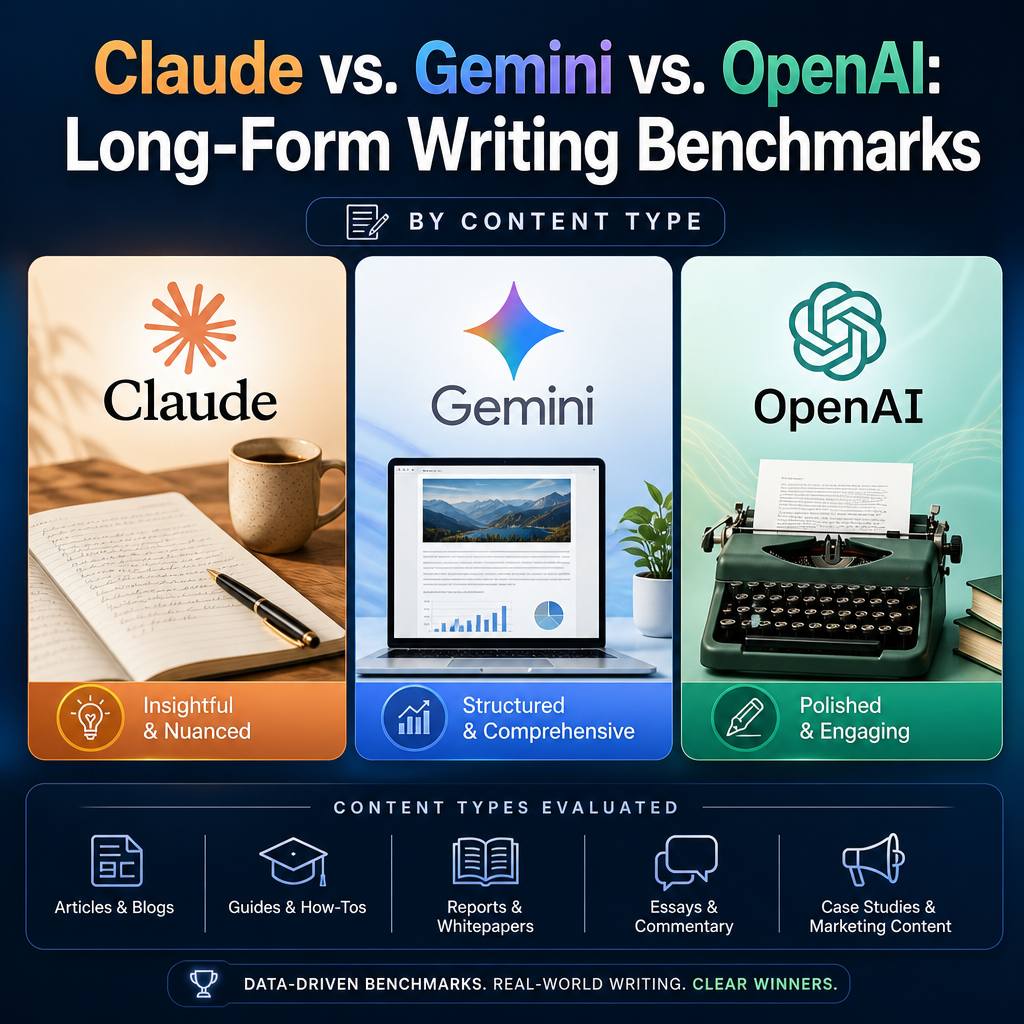
Claude vs. Gemini vs. OpenAI: Long-Form Writing Benchmarks by Content Type
Claude vs. Gemini vs. OpenAI for Long-Form Writing: A Practical Benchmark by Content Archetype
The best AI model for a 2,000-word tutorial may not be the best one for a reported feature. A tutorial can sound plain and still do its job. A feature with flawless grammar can fail because the narrative goes nowhere. That’s why a useful Claude vs. Gemini vs. OpenAI for long-form writing benchmark starts with the kind of article you actually publish.
This benchmark is a test plan, not a set of measured results. The model suggestions below are starting points, not rankings. The goal is to find which model produces the most publishable draft with the least editorial rework.

Set Up a Fair Writing Test
Pick two real briefs for each content archetype you publish regularly. Give Claude, Gemini, and an OpenAI GPT model the same brief, source packet, target length, and style guide. Record the exact model versions and use fresh chats so earlier conversations don’t influence the drafts.

If you want to compare writing rather than research tools, turn off browsing and supply the same source material to all three. If your everyday workflow depends on browsing or file integrations, run a separate test with those features enabled and label it as a workflow comparison.
Strip out model names before reviewing the drafts. Then give each model one revision pass with the same instruction, such as: “Cut the introduction by half, preserve every caveat, and leave the rest of the article unchanged.”
Compare Models by Content Archetype
1. Reported Features: Voice and Narrative Momentum
Give each model interview excerpts, background notes, and a clear angle. Ask for a scene-led opening that uses only details documented in the source packet. Claude is a reasonable first candidate to test here, but let the middle of the draft decide the result, not the opening paragraph.
Check whether the story develops or simply strings together quotes. Verify quotations and scene details against the notes. A vivid opening that invents what the room looked like is a factual failure, not a stylistic win.
2. Research Explainers: Accurate Synthesis
Supply several sources that disagree in useful ways. For example, give the models two studies that report different outcomes because they measure different populations. Gemini is a useful candidate to test on a dense source packet, alongside Claude and GPT.
Look for a draft that explains why the findings differ without pretending the disagreement is settled. Spot-check whether each cited source supports the sentence attached to it. A long reference list means little if the claims are stronger than the evidence.
3. Tutorials and SEO Guides: Structure and Usability
Give each model a reader profile, a target search intent, and a few nonnegotiable details. An OpenAI GPT model is a practical starting candidate when you need to test adherence to a detailed brief. Use a task you can actually walk through rather than judging the draft on how orderly it looks.
Does the article answer the main question early? Are prerequisites introduced before they’re needed? Would a first-time reader know what to do after each step? A draft that checks every heading box but skips a crucial setup step should score poorly.
4. Thought Leadership: Argument and Specificity
Provide a clear position, first-hand observations, and one credible counterargument. Test all three models on whether they can develop the author’s reasoning without turning it into generic advice.
Read the conclusion first: does it follow from the argument, or could it sit at the end of almost any article on the subject? Then check whether the model engaged with the counterargument instead of dismissing it in a sentence.
Score for Publishability, Not Polish
Rate each draft from 1 to 5 on source fidelity, structure, voice, reader usefulness, and revision control. Weight the criteria by archetype: voice should count more in a feature, while accuracy and usability should dominate a tutorial. Treat fabricated quotes or unsupported central claims as disqualifying rather than letting high style scores offset them.
Finally, track the active editing minutes needed to reach publication. Separate ordinary copyedits from deeper repairs, such as rebuilding the argument or correcting claims. A rough draft with sound reporting might take less time to publish than a polished one you have to fact-check line by line.
The benchmark has done its job when you know which model to reach for on the next brief—not when you’ve crowned a universal winner.