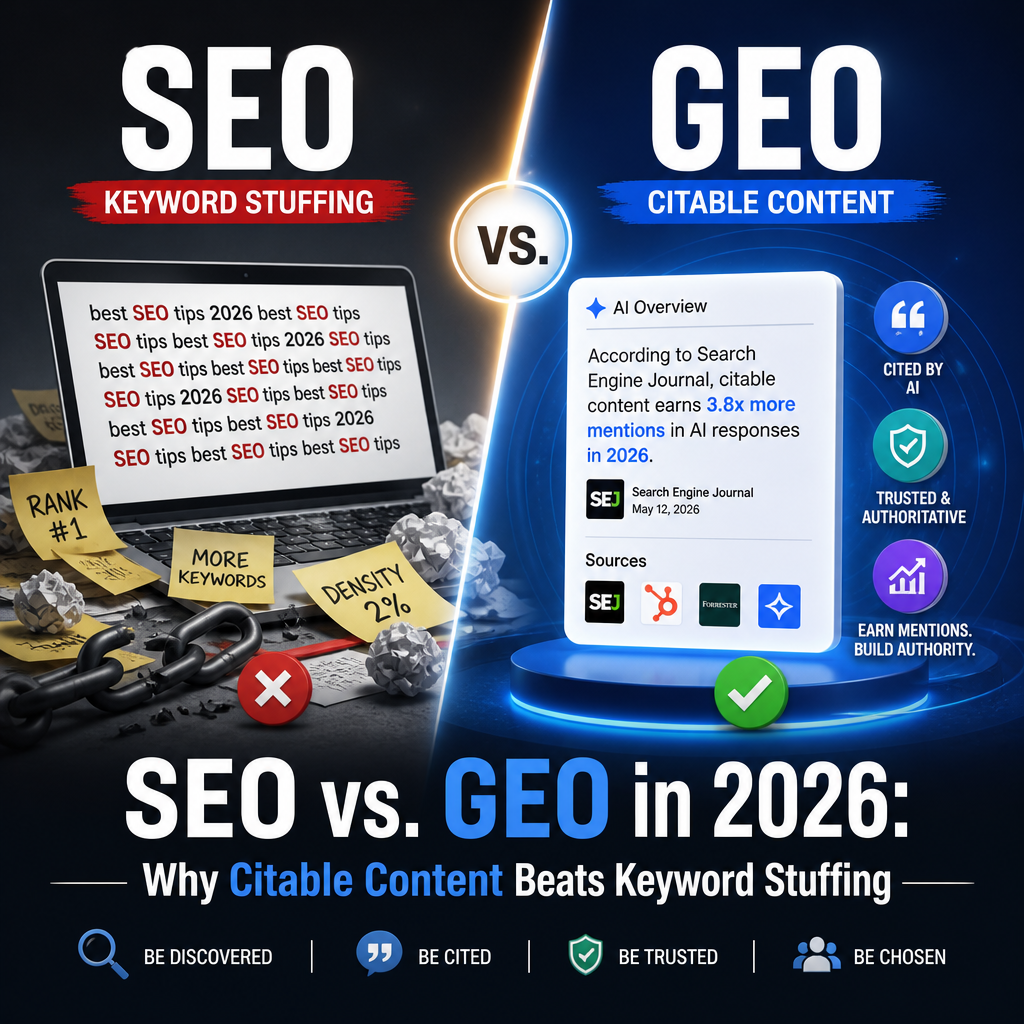
SEO vs. GEO in 2026: Why Citable Content Beats Keyword Stuffing
SEO vs. GEO in 2026: Why Citation-Worthy Depth Beats Keyword Stuffing Every Time
A page can rank for a question and still give readers no reason to trust its answer. It can also appear in an AI-generated response without earning a click. Those two realities make the SEO vs. GEO debate more useful than it sounds: it asks what your content delivers after a search engine or AI assistant finds it.
The answer isn’t to repeat your target phrase more often. It’s to publish something worth referencing: a clear answer, credible evidence, and enough context for readers to know whether the advice applies to them.

SEO vs. GEO: What’s the Difference?
Search engine optimization (SEO) helps people discover your pages through search. It includes making pages accessible to search engines, matching content to search intent, and writing titles and headings that tell readers what they’ll find.

Generative engine optimization (GEO) focuses on making your content easier for AI-powered search tools and assistants to find, interpret, and potentially reference in generated answers. The distinction isn’t absolute: a single search experience can show both traditional links and a generated summary. And no formatting trick guarantees an AI citation.
Think of SEO as helping the right reader find your page. GEO adds a second question: if a tool summarizes the topic, what specific claim, example, or finding would make your page worth citing?
Why Keyword Stuffing Falls Short
Keywords still matter. If someone searches for “how to clean a cast-iron skillet,” that phrase tells you what they need. Using it naturally in a title or introduction makes the topic clear. Repeating it in every heading doesn’t answer whether dish soap is safe, how to remove stuck-on food, or why drying the pan matters.
That’s the difference between naming a question and resolving it. Keyword stuffing takes up space you could use for instructions, evidence, or caveats. It can also make a page harder to read without making any individual passage more useful to quote.
Depth doesn’t mean writing a longer article. A 500-word guide that answers the main question, handles a common exception, and links to a reliable source can be more useful than 2,000 words of generic advice.
What Makes Content Citation-Worthy?
Lead With an Answer You Can Support
Put the direct answer near the top of the relevant section, then explain why it holds and where it stops applying. For example, “Compressing images can improve load times” is a reasonable starting point. Showing how much a specific image shrank, which format you used, and whether the compressed version still looked sharp gives readers something they can verify and apply.
Show Where the Evidence Comes From
Link to the original study, official documentation, or dataset when you rely on someone else’s findings. When you publish your own test, explain what you measured and under what conditions. A result from one website or device can be useful without being universal, as long as you make that distinction clear.
Add Something the Reader Can’t Get Everywhere
A comparison table, annotated screenshot, or documented test can do more than another paragraph summarizing familiar advice. For a hosting comparison, for instance, explain what each plan costs at renewal, what the plans include, and which workloads you tested. That gives readers a basis for choosing instead of asking them to trust a “best overall” label.
How to Put SEO and GEO to Work Together
Start with one existing article that attracts impressions but gives a vague answer, or one that still gets traffic despite having outdated examples. Then revise it in this order:
- Identify the reader’s decision. What should someone be able to understand, choose, or do after reading?
- Make the answer easy to find. Use a descriptive title, clear headings, and a direct opening.
- Replace broad claims with specifics. Add a source, an example, or a test result wherever it would change what the reader does next.
- Check the basics. Confirm that the page can be crawled and indexed, that important information appears in readable text, and that relevant pages on your site link to it.
Track search impressions, clicks, and the actions that matter to your site. Where referral data or citation monitoring is available, track those signals separately: a mention in a generated answer isn’t the same as a visit, and a visit isn’t the same as a conversion.
The best test is simpler than any dashboard: if someone quoted one paragraph from your page, would that paragraph communicate a useful, supportable idea? If not, adding the keyword one more time won’t fix it.
