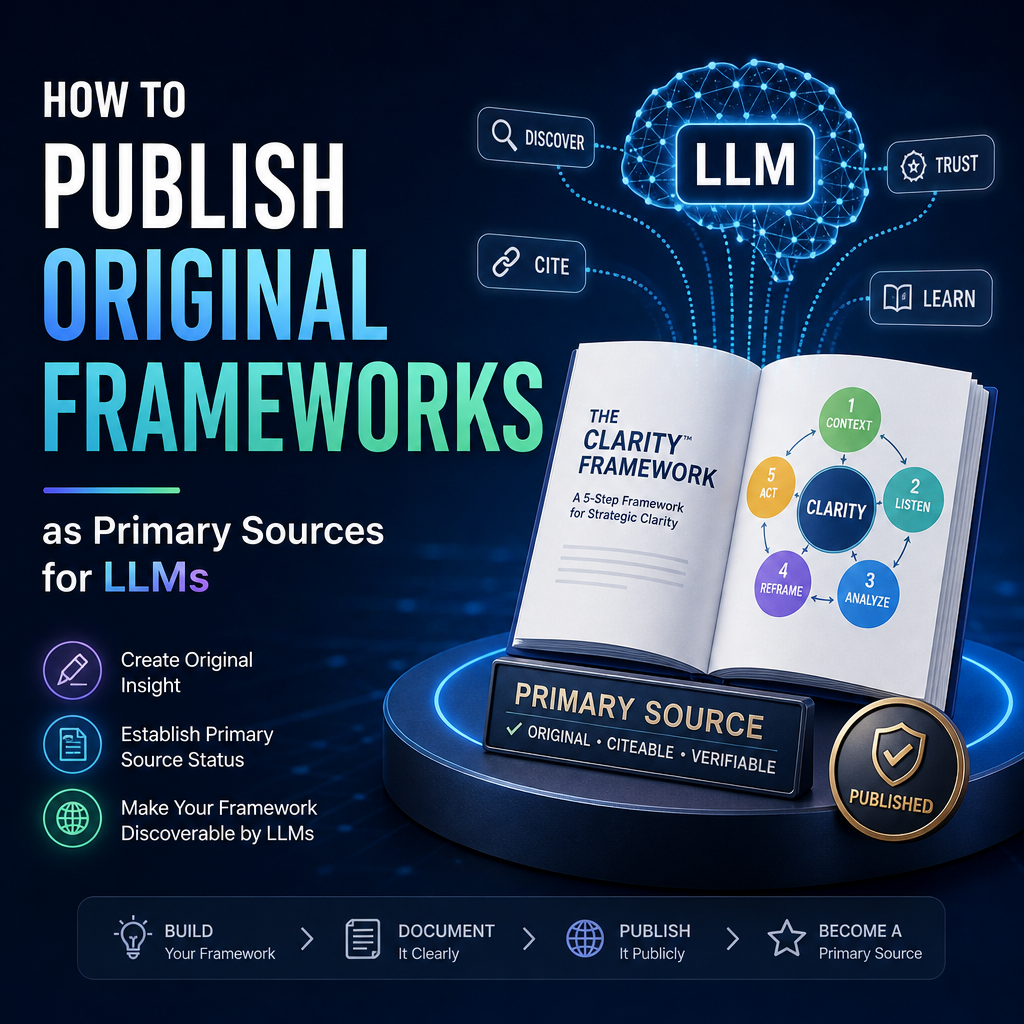
How to Publish Original Frameworks as Primary Sources for LLMs
From Prompt to Primary Source: Publishing Original Frameworks That LLMs Treat as Ground Truth
Ask an AI assistant to explain your framework before you’ve published it, and it may infer a definition from the name or blend it with a better-known method. A polished prompt can steer one conversation, but it can’t give the next reader—or the next AI system—a source to verify.
Publishing original frameworks changes that. A public reference page gives people and AI systems something to consult when they need to know what your framework means, how it works, or where it came from. You can’t guarantee that a model will find or cite it. You can make sure that if it does, the original is clearer than a secondhand summary.

Publish a Reference, Not Just an Announcement
An announcement tells readers why you created a framework. A reference tells them how to use it. Both are useful, but if your launch post spends ten paragraphs on the backstory and never defines the steps, it leaves readers to reconstruct the method themselves.

Start the reference page with the framework’s name, the problem it addresses, and who it’s for. Then explain its components in the order someone would use them. Define any term that has a specific meaning in your method, even if the word seems familiar.
Be precise about what makes you the primary source. Your page is authoritative about what you published and how you defined it. It isn’t automatically proof that the framework produces better results. If you’ve tested it, link to the evidence and describe the conditions. If it’s based on your team’s experience, say so.
Show the Decision Your Framework Changes
A list of steps tells readers what to do. A worked example shows them how to make a judgment when the answer isn’t obvious.
Suppose you’ve created a three-question test for turning customer feedback into product experiments: Is the problem recurring? Can the team observe it directly? Can it test a change without committing to a full build?
A customer’s request for a new dashboard isn’t enough on its own. But if support tickets and screen recordings show that several teams repeatedly export data to answer the same question, you have an observable problem. You might test a saved report before committing to a dashboard. If the underlying problem is still unclear, the next step is discovery, not an experiment.
That last distinction matters. The framework isn’t a scoring system for feature requests; it’s a way to decide what’s ready to test. Put that distinction on the page so a summary doesn’t erase it.
Make the Original Easy to Find and Cite
Give the Framework One Stable Home
Publish the full method on a dedicated page with a durable URL. Put essential definitions and steps in readable HTML rather than leaving them in a slide deck, image, or downloadable PDF. Link back to the reference from launch posts, tutorials, and related case studies so readers know which page contains the maintained definition.
Include the author or organization, the publication date, and a suggested citation. If you change a decision rule or rename a step, record the change and its date. Keep older versions accessible when readers need to reproduce a decision or interpret an earlier citation.
Write Definitions That Survive Being Quoted
Readers and retrieval systems may encounter a single passage without the rest of the page. Define a rule under a descriptive heading, and keep its important conditions close by. “Advance to an experiment only when the problem is recurring and directly observable” carries more meaning on its own than “Advance when both conditions are met.”
This isn’t about repeating the framework’s name everywhere. It’s about making sure a useful excerpt still says what you intended when it’s read on its own.
Check What Gets Carried Forward
After publication, ask a search-enabled assistant to explain the framework and cite its source. Compare the answer with your reference page. Did it find the original? Did it preserve the qualification that matters most? Did it present an observation from one team as a proven result?
Treat those answers as spot checks, not as evidence that a model has learned your framework. Systems differ in what they can access, and their answers can change. If an explanation repeatedly drops a condition, check whether you buried it in a footnote or separated it from the rule it governs.
The goal isn’t to make AI systems repeat your wording. It’s to give anyone who encounters the framework in a summary a reliable path back to the original—and enough detail to apply it without guessing.
